Growth Forecast
Winter/Spring 2026
Interview by Erin Vivid Riley
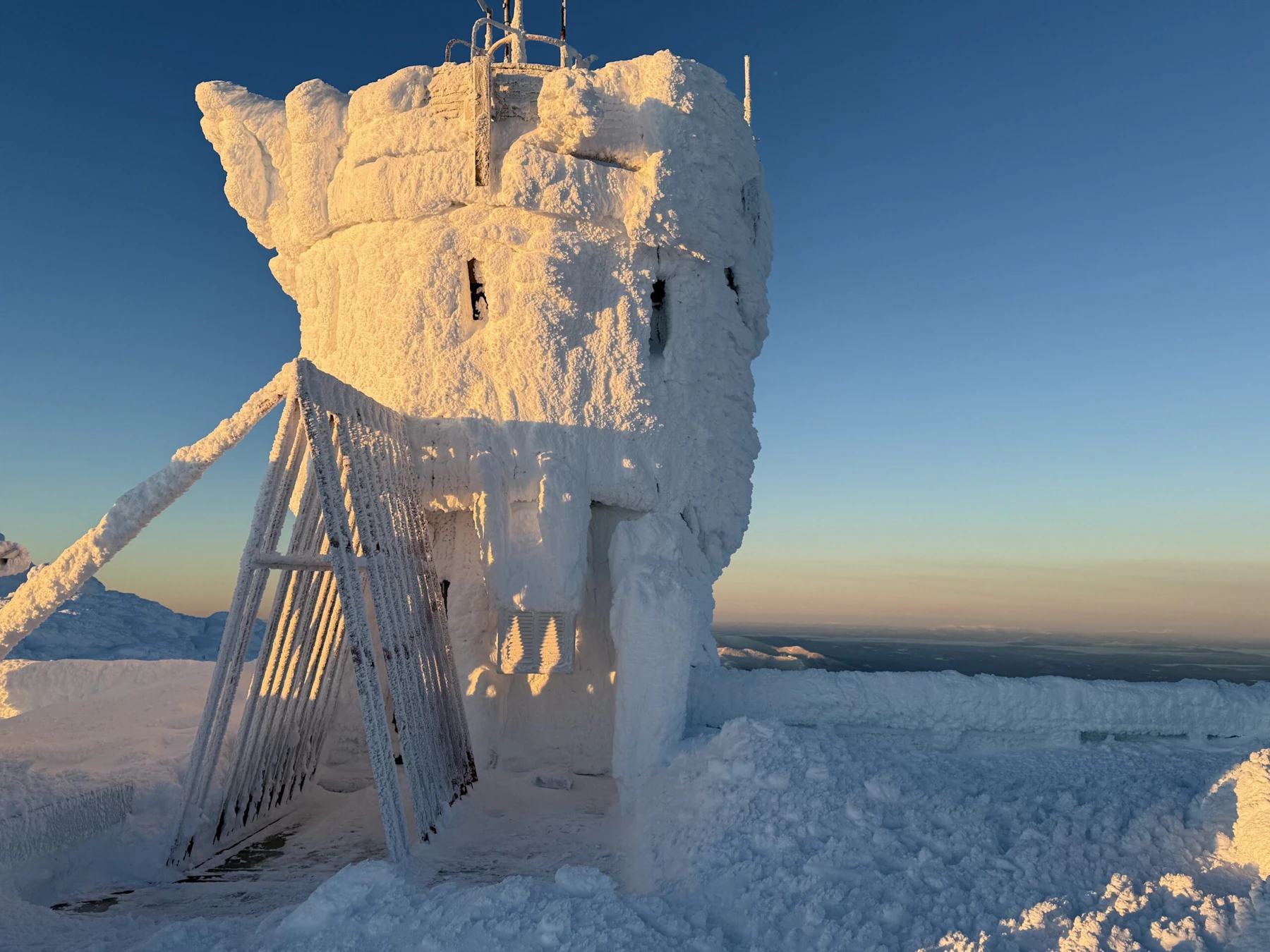
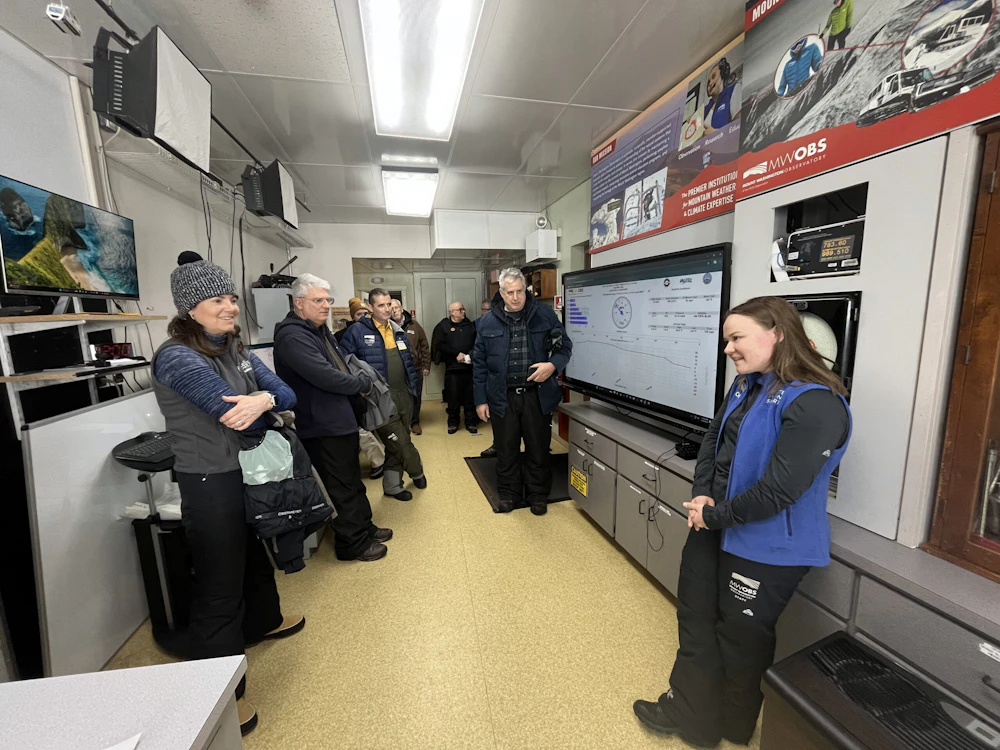
In June 2025, Amy Cotter was monitoring wind speed on the 6,288-foot summit of Mount Washington when she noticed unusually high numbers for a summer day. Cotter and her colleagues gathered in the observatory’s weather room, watching as the anemometers clocked 124 miles per hour, breaking records. “The anticipation was so exciting,” says Cotter, a weather observer and education specialist at Mount Washington Observatory.
Most weather nerds know of Mount Washington, encircled by New Hampshire’s White Mountain National Forest, as home to the world’s worst weather. Although its elevation isn’t comparable to mountains out West, the fact that it’s the tallest point within a nearly 800-mile radius means it’s exposed to a lot of weather. “There are no buffers,” says Cotter, who adds that the topography of the White Mountains creates a funneling effect, channeling those winds to the observatory.
The Observatory has maintained a weather station on the summit since 1932, creating a valuable long-term record for climate studies. We spoke to Cotter about why keeping its weather-monitoring technology cutting-edge is crucial in the face of a changing climate.
What does a typical day look like for you?
I’m usually one of two daytime observers conducting hourly weather observations, from using instruments to measure wind speed and pressure to using our eyes to gauge visibility or cloud cover. Those observations are sent to the National Weather Service and, of course, stored in our over 90-year-old climate data set. We’re also doing a lot of forecasting for various entities, including public radio. As an education specialist, I also do lots of distance-learning programs.
Why is the science behind Mount Washington’s weather unique?
Along with Mount Washington’s prominence and topography, it’s how the country’s storms behave. Because of atmospheric dynamics and the west-to-east direction of the jet stream, a lot of storms across the country are funneled through the northeast. Combine that with the fact that Mount Washington is the tallest point in 800 miles in any direction and the funneling effect of the White’s topography, and we get a whole lot of storms directed our way.
What recent technological advancements have impacted your work?
Our network of weather stations can withstand intense cold, high precipitation volume, icing, and hurricane-force winds. But they rely on solar power, so if we have long stretches of bad weather, it can prevent transmission and create gaps in the data. But a recent half-million-dollar grant means we can update existing stations so that they run for up to 30 days without sunlight, as well as add more stations.
“A recent half-million-dollar grant means we can update existing stations so that they run for up to 30 days without sunlight, as well as add more stations.”
Why was this investment so important?
The more accurate data we have, the better our forecasts. Many industries rely on these predictions to function, from agriculture and conservation to tourism. Beyond that, data provided by the observatory helps inform big policy decisions in the face of a shifting world.

How do you spend your time off the summit?
I spend a lot of my time trail running on the White Mountain National Forest, especially on the Bondcliff Trail, which traces all three mountains that make up the Bonds. The views are absolutely breathtaking.
Follow Mount Washington Observatory on Instagram @mwobs. Visit the observatory’s weather station and museum, located at the Sherman Adams Visitor Center in Mount Washington State Park. Between mid-May to mid-October, you can reach the summit of New England’s highest peak via car, train, or on foot.
Want to receive a physical copy of Light & Seed® in your mailbox? Become an annual donor of $25 or more to start receiving your copy twice a year.
Our Forests Need Us Today.
Your donation powers critical, on-the-ground conservation—from wildfire recovery to watershed restoration—protecting forests for the future.