About 80 miles south of Eugene, Oregon, Anna Wemple pilots her pickup down a dirt road and over a bridge that spans the frothy North Umpqua River. She parks. Soon, we’re hiking up a steep hillside tangled with red capped raspberries, bracken ferns, and patches of poison oak. An immature bald eagle coasts by on the cool morning air.
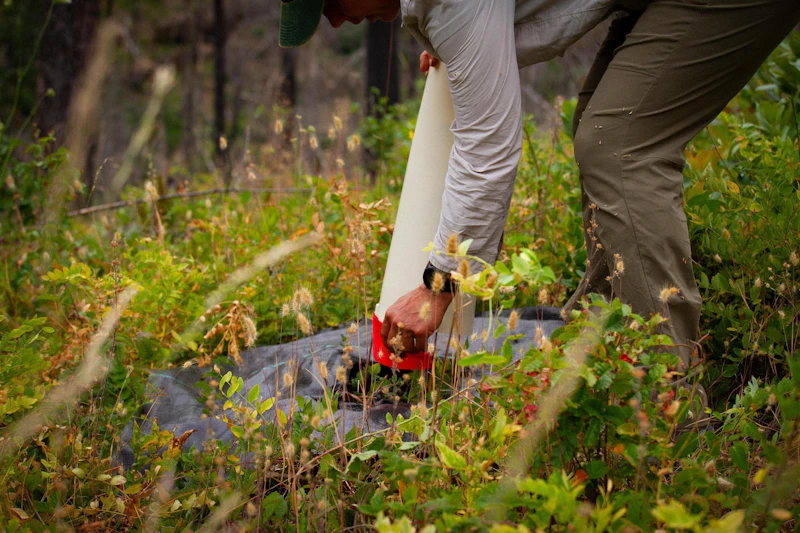
A short distance later, Wemple stops to inspect a delicate sapling protruding from a protective plastic cone. “These guys are doing really good,” she says, delighted. Dozens of them pepper the hillside in a grid pattern planted roughly 20 feet apart. “This is fantastic,” she says. “I’m so glad to see them alive.”
Wemple is the National Forest Foundation’s coordinator for reforestation efforts happening on this section of the 983,000-acre Umpqua National Forest, Oregon’s eighth largest. It is an Endor of life, with more than 60 mammal species, 236 types of birds, and hundreds of miles of cold, clear rivers that provide habitat for salmon, steelhead, and sea-run cutthroat trout.
Over the past two decades, however, at least three wildfires have ripped through this particular swatch of the Umpqua. The last one, the human-caused Jack Fire in 2021, scorched nearly 25,000 acres.

Wemple motions across the landscape where she’s organized the replanting of 5,000 trees in this burn scar, which had been dominated by Douglas firs in recent decades. But these saplings are different and special. They’re all Oregon white oaks, a native species with rounded lobed leaves and furrowed bark that historically ranged from southern British Columbia to northern California.
The populations that grow in southwestern Oregon represent the core of the species range and contain some of its healthiest and most genetically diverse stands. They’re in trouble, though. Today, as much as 98 percent of the tree’s range has vanished because of wildfire, a changing climate, and encroachment by species economically suited for timber.

“The oak habitat co-evolved with humans over many thousands of years and it developed into the most biodiverse habitat in our region,” Wemple says. “This ecosystem couldn’t persist without humans.”
For eons, Native Americans managed the oak savannah with low intensity burning to flush out wildlife for hunting. Today, land managers are restoring oak habitat by planting oak seedlings within burn scars such as this one. Each of the saplings—500 in all—in this 11-acre orchard were grown using acorns chosen from various stands around Oregon by scientists looking to capture a rich swatch of genetic variation within the species. This grove is a living seed bank. Some of the trees grown from this next generation of acorns may prove to be more drought resistant. Others may thrive in certain soils. All of them will produce seeds that will be used in future reforestation efforts.
"Each of the saplings...were grown using acorns chosen from various stands around Oregon by scientists looking to capture a rich swatch of genetic variation."
Two additional orchards, one in the Rogue River-Siskiyou National Forest and one in the Willamette National Forest, create redundancy in case a wildfire wipes one out. A bigger overarching goal is to slow the oak’s long, post-colonial slide into oblivion.
Wemple is perfect for this mission. She’s the daughter of two early members of the Hoedads, that merry band of tree planters that sprang out of Eugene in the 1970s. Wemple spent her formative years bouncing around the Pacific Northwest working on forests and estimates her two hands have sunk at least half a million trees into the Earth. Her dad planted a million. Her goal is to plant a million, too.

The hard work, the community, the greater sense of purpose: It all sustains her like so much sap. It did come with a price, though. She has spent so much time being outside that to this day she struggles to sleep in a hotel. Even so, this white oak mission is hardly hers.
“She made it a reality, though,” says Bryan Reatini, a geneticist with the Forest Service.
Reatini, who has worked closely with Wemple on the Umpqua site, says the idea of making a concerted effort to preserve the genetic diversity of Oregon white oaks has evolved over time but it owes much of its existence to his predecessor, Scott Kolpack, who is now a Forest Service geneticist in California. Kolpack has studied genetic variation in cedars and firs and how those genes translate into wood stiffness or resilience to disease, among other topics.
When he turned his attention to the Oregon white oak, he began to curate a robust set of acorns with the Forest Service’s Dorena Genetic Resource Center, the agency’s epicenter for applied genetics in the Pacific Northwest. The acorns could preserve the diversity of the species. The saplings at our feet came from that work.

“We’re helping the folks that are planting trees and managing existing stands to make sure they have the support they need,” Reatini says. “By ensuring that the seeds are genetically diverse, we can give our restoration activities the best chance of success.”
"By ensuring that the seeds are genetically diverse, we can give our restoration activities the best chance of success.”
That wasn’t a sure thing. In the summer of 2024, Reatini took over the white oak project as Kolpack assumed his new position. The handover meant Reatini was now in charge of finding the sites, the funding, and the means to get the white oaks actually planted. He found the perfect partner in the National Forest Foundation and specifically in Wemple, who had already been working to reforest vast portions of the Jack Fire burn.
Wemple and I stand on a sooty fallen fir and gaze over the rugged terrain. She wows me with tidbits about the oaks themselves. Almost 200 years ago, botanist David Douglas—the Douglas in Douglas fir—named the tree the Garry oak after his friend Nicholas Garry, a deputy governor for the Hudson’s Bay Company, the commercial enterprise that started in 1670 that played a significant role in the development of the Columbia River Basin. I discover how they grow slowly, getting up to five feet thick over half a millennium. I learn how the oaks can support 200 different species of wildlife, like black-tailed deer, woodpeckers, butterflies, and bluebirds.
Wemple and I make our way back to the truck. On the way I stop next to a sapling and run my fingers over its leaves. I ask her why this particular project is meaningful to her. “These oaks support so much life,” she said. “I feel a deep obligation to do what we can to restore it.
Support the efforts on the Umpqua by contributing to the National Forest Foundation’s holistic reforestation program, a partnership with the Forest Service. The agency estimates that four million acres of reforestation is needed on National Forests—an area larger than the state of Connecticut—and with your help, the NFF is helping meet that critical demand.
About the Author
Tim Neville is a contributing editor at Outside magazine who lives in Bend, Oregon. He keeps a mental list of favorite trees from around the world that he’s been lucky enough to sit under.
Want to receive a physical copy of Light & Seed® in your mailbox? Become an annual donor of $25 or more to start receiving your copy twice a year.
Our Forests Need Us Today.
Your donation powers critical, on-the-ground conservation—from wildfire recovery to watershed restoration—protecting forests for the future.